
1

Because it creates an even stronger illusion of “truth,” increasing the risk of more pain in the lives of current and future generations.
1

Because everyone sees the world in their own way + no one knows the truth.
Therefore, right / wrong and “mistakes” are fictional categories that distort perception.
Therefore, right / wrong and “mistakes” are fictional categories that distort perception.
The same goes for anything: health, communication, work, hobbies, etc.
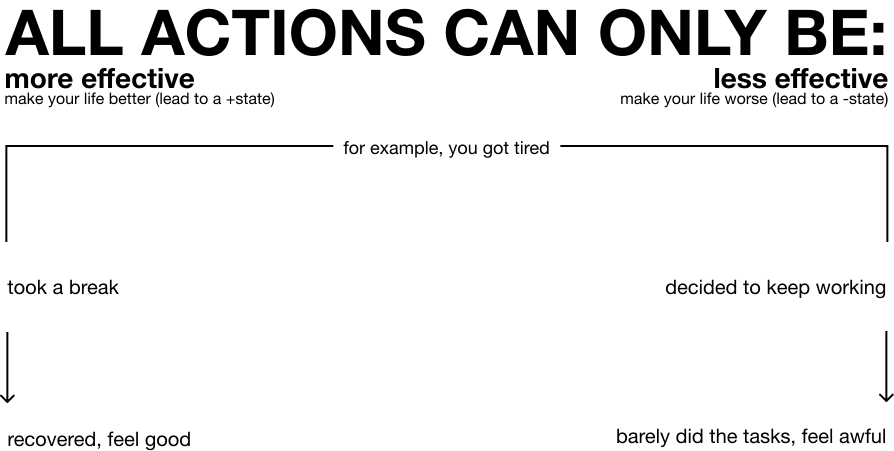
That is, every action makes your state – your life – better and / or worse to some degree.
Therefore:
When a person perceives the world through the category of “most and least effective,” they are able to live their best life, because each choice is directed toward improving their circumstances.
When a person perceives the world through the categories of “right / wrong” and “mistakes,” they become a hostage to everything society takes to be “truth / mistake / rule, etc.”. As a result, they will experience as much pain as they build their life against themselves.
That is, every action makes your state – your life – better and / or worse to some degree.
Therefore:
When a person perceives the world through the category of “most and least effective,” they are able to live their best life, because each choice is directed toward improving their circumstances.
When a person perceives the world through the categories of “right / wrong” and “mistakes,” they become a hostage to everything society takes to be “truth / mistake / rule, etc.”. As a result, they will experience as much pain as they build their life against themselves.
2
1

Because:
1. everyone sees the world in their own way + no one knows the truth;
2. the cause of any decision a person makes is perception, which was shaped by the structure of society, not independently by the person.
Therefore, guilt is a fictional category that distorts perception.
When a person has violated someone else’s boundaries, it is enough to bear the responsibility established by law. So any accusation is a conscious and / or unconscious attempt to make one’s opinion the single norm for everyone.
1. everyone sees the world in their own way + no one knows the truth;
2. the cause of any decision a person makes is perception, which was shaped by the structure of society, not independently by the person.
Therefore, guilt is a fictional category that distorts perception.
When a person has violated someone else’s boundaries, it is enough to bear the responsibility established by law. So any accusation is a conscious and / or unconscious attempt to make one’s opinion the single norm for everyone.
1

Because:
1. everyone sees the world in their own way + no one knows the truth;
2. the cause of any decision a person makes is perception, which was shaped by the structure of society, not independently by the person.
Therefore, morality is a fictional category that distorts perception.
It teaches you to label people and things and divide the world into black and white before you even become aware of it. As a result, a person:
- does not live their own life (because they use imposed scripts rather than forming a personal view of what is happening);
- makes the least beneficial choices, since they take less context into account.
The thing is, nearly all communication is structured around morality – both direct, such as conversations, and indirect, such as films, fairy tales, advertising, etc. People have been labeling things for thousands of years, while none of this exists in life:
- good and evil, honor, justice, dignity, vice, mercy, etc.
- hero / antihero, brave / coward, talented / untalented, champion / loser, altruist / egoist, loyal / traitor, etc.
In other words, society’s understanding of life is deeply distorted.
1. everyone sees the world in their own way + no one knows the truth;
2. the cause of any decision a person makes is perception, which was shaped by the structure of society, not independently by the person.
Therefore, morality is a fictional category that distorts perception.
It teaches you to label people and things and divide the world into black and white before you even become aware of it. As a result, a person:
- does not live their own life (because they use imposed scripts rather than forming a personal view of what is happening);
- makes the least beneficial choices, since they take less context into account.
The thing is, nearly all communication is structured around morality – both direct, such as conversations, and indirect, such as films, fairy tales, advertising, etc. People have been labeling things for thousands of years, while none of this exists in life:
- good and evil, honor, justice, dignity, vice, mercy, etc.
- hero / antihero, brave / coward, talented / untalented, champion / loser, altruist / egoist, loyal / traitor, etc.
In other words, society’s understanding of life is deeply distorted.
1

Because they are fictional, illogical categories that people continue to present, generation after generation, as “fundamental, noble, beautiful, and so on”:
↓ Help is not given just because it's asked for.
A person helps only when they see meaning in it (whether imposed or not).
Otherwise, those whose actions are considered selfless would spend their entire lives only solving other people’s problems, leaving no time even to cover their own basic needs.
↓ Beliefs themselves influence what a person’s state will be after what happened.
↓ So, the desire to feel better, not worse, is the impulse to act.
↓ In other words:
↓ Help is not given just because it's asked for.
A person helps only when they see meaning in it (whether imposed or not).
Otherwise, those whose actions are considered selfless would spend their entire lives only solving other people’s problems, leaving no time even to cover their own basic needs.
↓ Beliefs themselves influence what a person’s state will be after what happened.
↓ So, the desire to feel better, not worse, is the impulse to act.
↓ In other words:
2

1

Because:
1. everyone sees the world in their own way + no one knows the truth;
2. the cause of any decision a person makes is perception, which was shaped by the structure of society, not independently by the person.
Therefore, evaluations and criticism outside of personal opinion are fictional categories that distort perception.
Evaluating others is like asking film characters to judge each other based on just one minute of the movie.
You do not know:
- what goals a person has;
- what kind of perception they were given, how they see themselves and the world;
- how strongly the structure of society has distorted their perception / how much additional self-sabotage they have to deal with;
- what they have already been through and what they will go through;
- whether they had the opportunity to have the kind of experience that could be considered average, or whether their past was extremely atypical;
- how the person will behave in the future;
- how the future will affect you, and how much your perception of what is happening and of that person will change;
- etc.
1. everyone sees the world in their own way + no one knows the truth;
2. the cause of any decision a person makes is perception, which was shaped by the structure of society, not independently by the person.
Therefore, evaluations and criticism outside of personal opinion are fictional categories that distort perception.
Evaluating others is like asking film characters to judge each other based on just one minute of the movie.
You do not know:
- what goals a person has;
- what kind of perception they were given, how they see themselves and the world;
- how strongly the structure of society has distorted their perception / how much additional self-sabotage they have to deal with;
- what they have already been through and what they will go through;
- whether they had the opportunity to have the kind of experience that could be considered average, or whether their past was extremely atypical;
- how the person will behave in the future;
- how the future will affect you, and how much your perception of what is happening and of that person will change;
- etc.
1

Tension is a protective response. People tense up when a situation does not feel safe – just like animals freeze when they sense a threat.
A reaction like this in everyday situations is not a sign of weakness. It is a sign of how much a person’s boundaries were violated in the past.
A reaction like this in everyday situations is not a sign of weakness. It is a sign of how much a person’s boundaries were violated in the past.
These categories of thinking are a waste of time and energy on feelings and thoughts that could simply not exist at all.
In nature, animals don’t question themselves. If cheetahs don’t get food, they don’t think that something is wrong with them. On the contrary, the hungrier they get, the more their attention focuses on solving the task – finding food.
In nature, animals don’t question themselves. If cheetahs don’t get food, they don’t think that something is wrong with them. On the contrary, the hungrier they get, the more their attention focuses on solving the task – finding food.
4

All people are different from birth – how can we compare that?
Besides, society distorted some people’s perception more in the past, and others’ less. So some people are forced to spend far more time and energy working through self-sabotage, living through difficult emotions, stress, attempts to understand themselves, etc. In other words, the same results will cost different people different amounts of effort.
Comparing yourself with someone else, or your results with someone else’s, is like comparing cars from different categories and in different states of repair. In other words, this makes no sense.
Besides, society distorted some people’s perception more in the past, and others’ less. So some people are forced to spend far more time and energy working through self-sabotage, living through difficult emotions, stress, attempts to understand themselves, etc. In other words, the same results will cost different people different amounts of effort.
Comparing yourself with someone else, or your results with someone else’s, is like comparing cars from different categories and in different states of repair. In other words, this makes no sense.
3

2

1

5

To me, it feels like “don’t compare yourself with others, compare yourself with yourself” has already become widely accepted.
What’s the problem?
A person in the future cannot handle things worse than in the past by default, because they will already have more experience.
*I don’t count comparing your results, including your states, as comparing yourself with yourself. Because to me, that is comparing results, not what you were and what you are now.
What’s the problem?
A person in the future cannot handle things worse than in the past by default, because they will already have more experience.
*I don’t count comparing your results, including your states, as comparing yourself with yourself. Because to me, that is comparing results, not what you were and what you are now.
Any evaluation of yourself contradicts logic because:
1. These evaluations don’t even have anything to do with what you are like – they reflect your current state:
- I like my life = I’m good enough;
- I don’t like something in my life = I’m not enough.
2. What you are like now was defined by the perception you were given, and by how the structure of society later distorted it. In other words, it’s a set of circumstances, not a choice.
Besides, every decision you’ve ever made was made in favor of the best option you were able to see at the moment of choice. That means that throughout life, a person does their maximum.
Therefore:
1. These evaluations don’t even have anything to do with what you are like – they reflect your current state:
- I like my life = I’m good enough;
- I don’t like something in my life = I’m not enough.
2. What you are like now was defined by the perception you were given, and by how the structure of society later distorted it. In other words, it’s a set of circumstances, not a choice.
Besides, every decision you’ve ever made was made in favor of the best option you were able to see at the moment of choice. That means that throughout life, a person does their maximum.
Therefore:
1

In my view, in society, people use the concept of “respect” however it suits them. Many examples can be given where manipulation is hidden behind the mask of “respect.” To avoid listing them all, I will describe what respect is for me:
It is behavior in which a person does not try to take the position of authority toward another person or toward themselves. In other words, it is following the principle of personal reality: people interact as equals, without taking the position of either judge or accused, etc. And if one person is unpleasant to another, they simply don’t communicate.
Therefore:
It is behavior in which a person does not try to take the position of authority toward another person or toward themselves. In other words, it is following the principle of personal reality: people interact as equals, without taking the position of either judge or accused, etc. And if one person is unpleasant to another, they simply don’t communicate.
Therefore:
Because no one knows the truth + everyone sees the world in their own way. So there are no people who can be above or below someone else. Everyone is different by default. That is, it does not matter how old someone is, what position they have, what capital they have, etc. – by right of birth, all people are equal to each other.
(This does not apply to skills, resources, etc. If someone runs faster than another person, their skill can be valued higher. But these people are equal to each other in terms of their significance.)
While the phrase “adults must be respected” breaks the essence of “respect” by default. All the cases where I have seen it used, in my view, were manipulations in which adults tried to take away the right to choose / have a voice or personal opinion from someone younger.
(This does not apply to skills, resources, etc. If someone runs faster than another person, their skill can be valued higher. But these people are equal to each other in terms of their significance.)
While the phrase “adults must be respected” breaks the essence of “respect” by default. All the cases where I have seen it used, in my view, were manipulations in which adults tried to take away the right to choose / have a voice or personal opinion from someone younger.
2

1

In my view, with phrases like “I believe that ...”, people can:
1. Describe an analysis of how likely something is – what, in practice, can be called intuition.
For example:
A person says: “I believe I’ll be able to create my own project.” The idea can be done, and he spends all his free time on work and quality recovery. This means the project is more likely to be released than not.
2. Consciously and / or unconsciously find external points of support for themselves in someone or something.
In the current structure of society, a child’s upbringing and education mostly happen through blind belief in the external: you either say what others want to hear from you, or you’re punished / wrong.
2.1. All of this leads to a situation where, as they grow up, many people are already so deeply convinced that someone outside them knows exactly what is better and how, that they trust an “authoritative” opinion more than themselves:
– scientists proved it;
– statistics showed it;
– a famous philosopher / psychologist, etc. said it;
– etc.
2.2. Because of this, “belief” can also make a person confuse intuition with self-sabotage.
For instance, instead of analyzing risks at the start, in some situations people may rely on chance. And if the situation doesn’t turn out in their favor, they’ll find someone “to blame” outside themselves, justifying themselves with “moral norms”:
For example:
A startup launch is in 3 weeks. The founder asks the employees to work all this time without days off and without extra pay. The employees answer: “no, thank you.” The founder’s reaction: “everyone let me down, the world is unfair to me.”
All of this makes the idea of “belief” a point of vulnerability. In different contexts, very different things can be hidden behind “I believe.”
To avoid false hopes from the start, I try to catch myself every time I say “I believe” out of habit, and replace it with “I perceive.”
This gives me the ability to clearly understand in the moment that this is not a lottery-like scenario of how things may be, but how I currently see the perspective.
It also allows me to quickly adapt my actions when new input appears, so I can keep the chance of achieving what I want instead of watching it fade while “believing until the very end.”
1. Describe an analysis of how likely something is – what, in practice, can be called intuition.
For example:
A person says: “I believe I’ll be able to create my own project.” The idea can be done, and he spends all his free time on work and quality recovery. This means the project is more likely to be released than not.
2. Consciously and / or unconsciously find external points of support for themselves in someone or something.
In the current structure of society, a child’s upbringing and education mostly happen through blind belief in the external: you either say what others want to hear from you, or you’re punished / wrong.
2.1. All of this leads to a situation where, as they grow up, many people are already so deeply convinced that someone outside them knows exactly what is better and how, that they trust an “authoritative” opinion more than themselves:
– scientists proved it;
– statistics showed it;
– a famous philosopher / psychologist, etc. said it;
– etc.
2.2. Because of this, “belief” can also make a person confuse intuition with self-sabotage.
For instance, instead of analyzing risks at the start, in some situations people may rely on chance. And if the situation doesn’t turn out in their favor, they’ll find someone “to blame” outside themselves, justifying themselves with “moral norms”:
For example:
A startup launch is in 3 weeks. The founder asks the employees to work all this time without days off and without extra pay. The employees answer: “no, thank you.” The founder’s reaction: “everyone let me down, the world is unfair to me.”
All of this makes the idea of “belief” a point of vulnerability. In different contexts, very different things can be hidden behind “I believe.”
To avoid false hopes from the start, I try to catch myself every time I say “I believe” out of habit, and replace it with “I perceive.”
This gives me the ability to clearly understand in the moment that this is not a lottery-like scenario of how things may be, but how I currently see the perspective.
It also allows me to quickly adapt my actions when new input appears, so I can keep the chance of achieving what I want instead of watching it fade while “believing until the very end.”
1

Hope, like belief, can be used in both constructive and destructive ways.
“I hope” is an alternative to “I want.” But if I say “I want,” I need to act. With “I hope,” the focus can shift to external things – a lucky set of circumstances – which creates a risk of inaction and pain.
To avoid this, I aim to replace “I hope” with “I want.”
“I hope” is an alternative to “I want.” But if I say “I want,” I need to act. With “I hope,” the focus can shift to external things – a lucky set of circumstances – which creates a risk of inaction and pain.
To avoid this, I aim to replace “I hope” with “I want.”